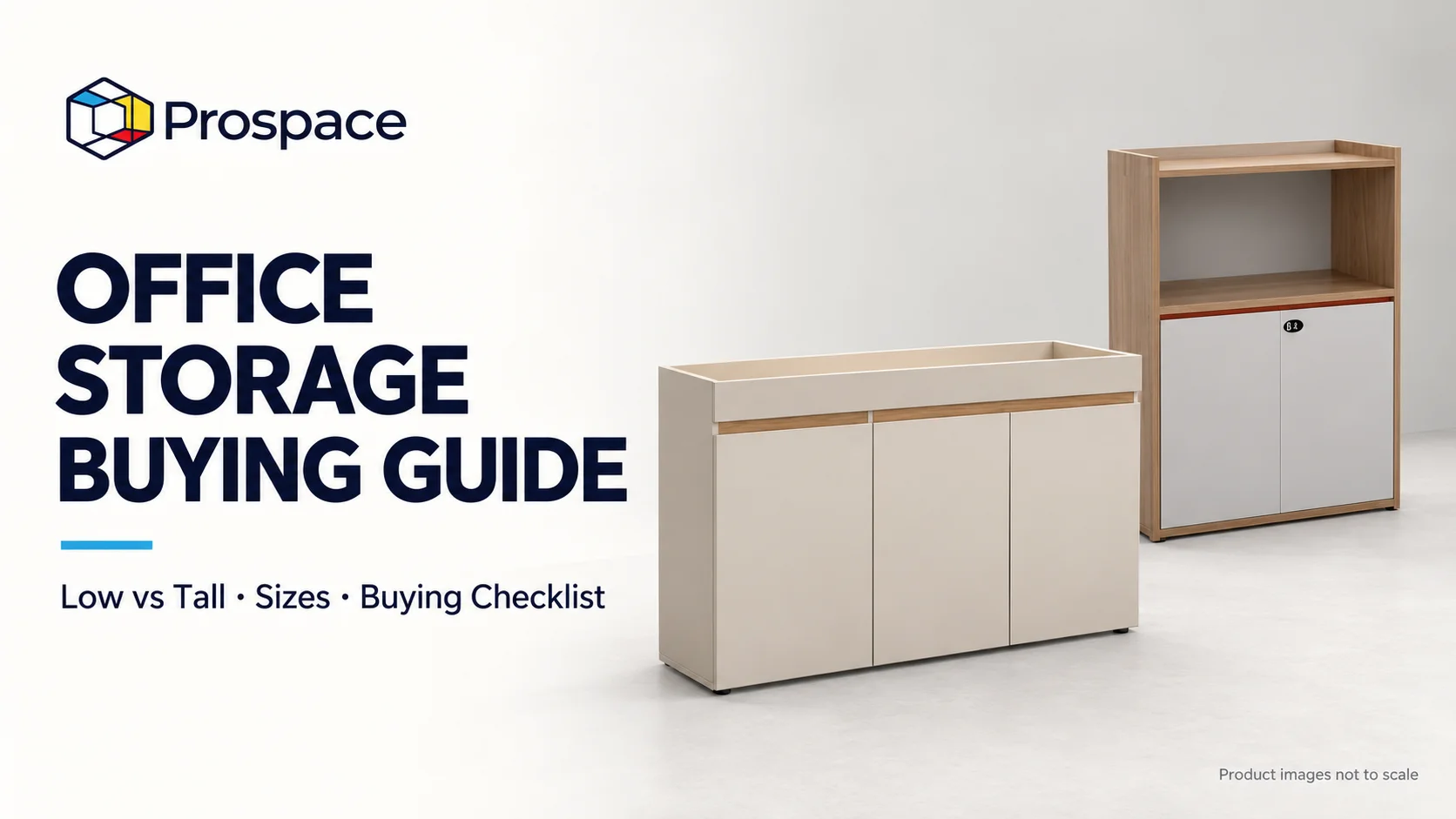
To choose office storage cabinets, start with what you need to store, how often people access it, and the space available. Compare low and tall units, check usable shelf dimensions, and confirm opening and delivery clearances before requesting a quotation.
A cabinet can fit against a wall yet fail to accommodate your binders or leave enough room to open its doors. For general affairs, facilities, and procurement teams, the aim is to match storage to everyday work—not simply fill an empty space.
This guide explains how to compare configurations and prepare a clear purchasing brief.
1. Start With What You Need to Store
List the contents before choosing a cabinet. Measure representative items, including the largest binder or storage box, and record how many you need to accommodate.
| Storage need | Configuration to consider | What to verify |
|---|---|---|
| Binders and box files | Shelves with suitable clear height and depth | Internal shelf dimensions and load rating |
| Hanging files | Drawers designed for hanging-file storage | Compatible file format, rails, and drawer extension |
| Shared office supplies | Shelves, compartments, or general storage drawers | Access frequency, organization, and item sizes |
| Restricted-access documents | A compartment with a confirmed locking mechanism | Which compartments lock and how keys are managed |
| Books and display items | Open shelving or a mixed configuration | Usable shelf space and permitted loading |
An ordinary drawer is not automatically compatible with hanging files. Likewise, a closed door does not necessarily include a lock.
Separate frequently used materials from reference archives. Keeping daily supplies near the people who use them can reduce unnecessary movement. Record expected growth so your quotation reflects future needs as well as today’s contents.
2. Low vs Tall Office Cabinets: Which Fits Your Office?
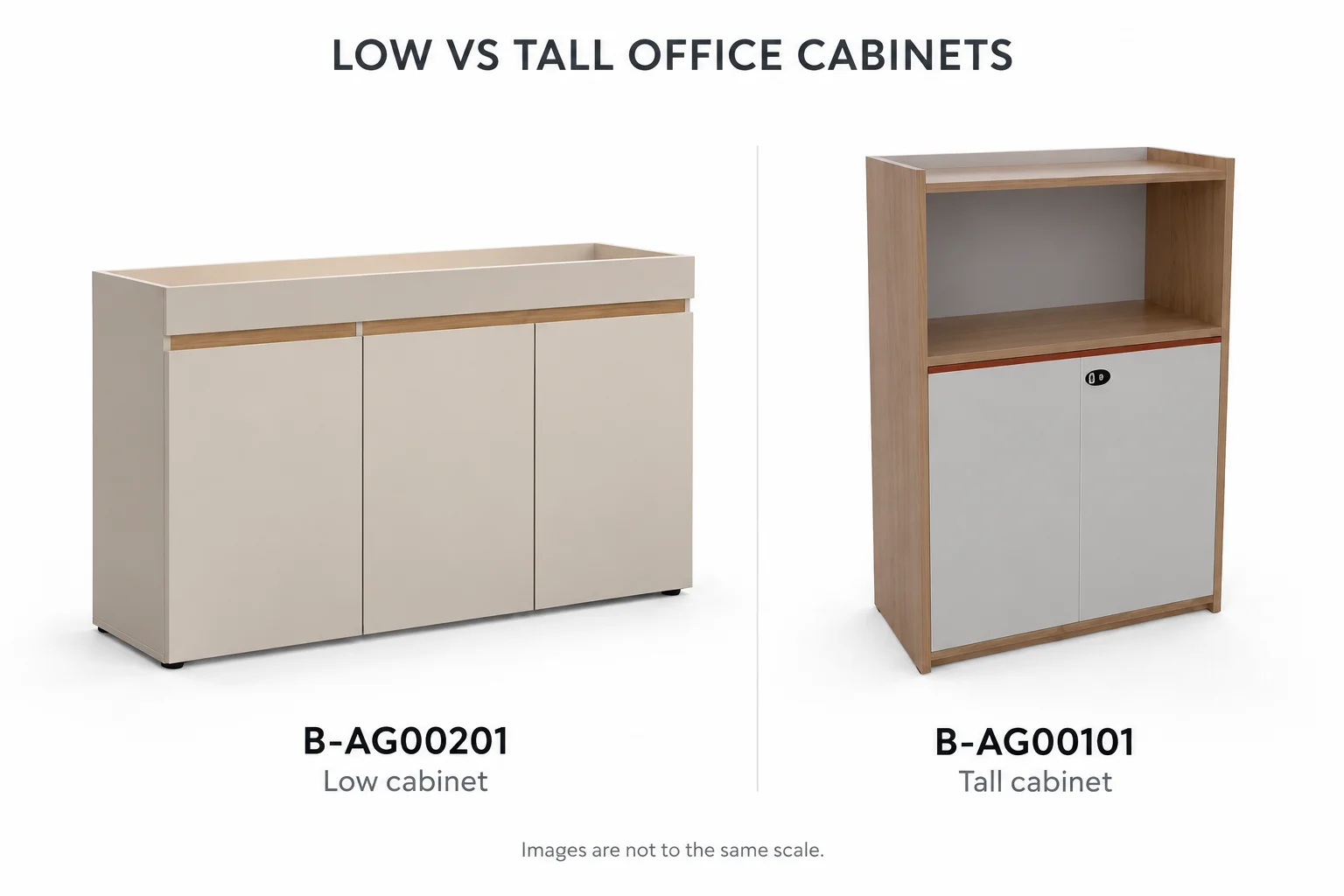
Low cabinets can suit shared storage where a lower profile matters. Taller cabinets can use wall height when additional shelf levels are needed. Neither configuration is automatically the better choice.
| Decision factor | Low cabinet | Tall cabinet |
|---|---|---|
| Everyday access | Can place contents on lower levels; check bending requirements | Can offer several storage levels; check reach to upper shelves |
| Room layout | Lower profile may suit open work areas | May suit wall positions where height is available |
| Floor footprint | Depends on actual width and depth | Also depends on width and depth; height alone proves no space saving |
| Opening space | Allow for doors or drawers and the user | Apply the same check to every accessible compartment |
| Main limitation | Available storage height may be insufficient | Upper storage and installation requirements need attention |
| Best comparison | Usable compartments versus your contents | Usable compartments versus your contents |
For example, a team accessing shared stationery throughout the day may prefer a low unit nearby. A department storing reference binders along a wall may consider a taller configuration, provided the shelves and access suit its users.
Browse low storage cabinets and tall storage cabinets after defining your needs. Treat category names as a starting point and compare actual measurements.
3. Measure the Cabinet, Opening Space, and Delivery Route
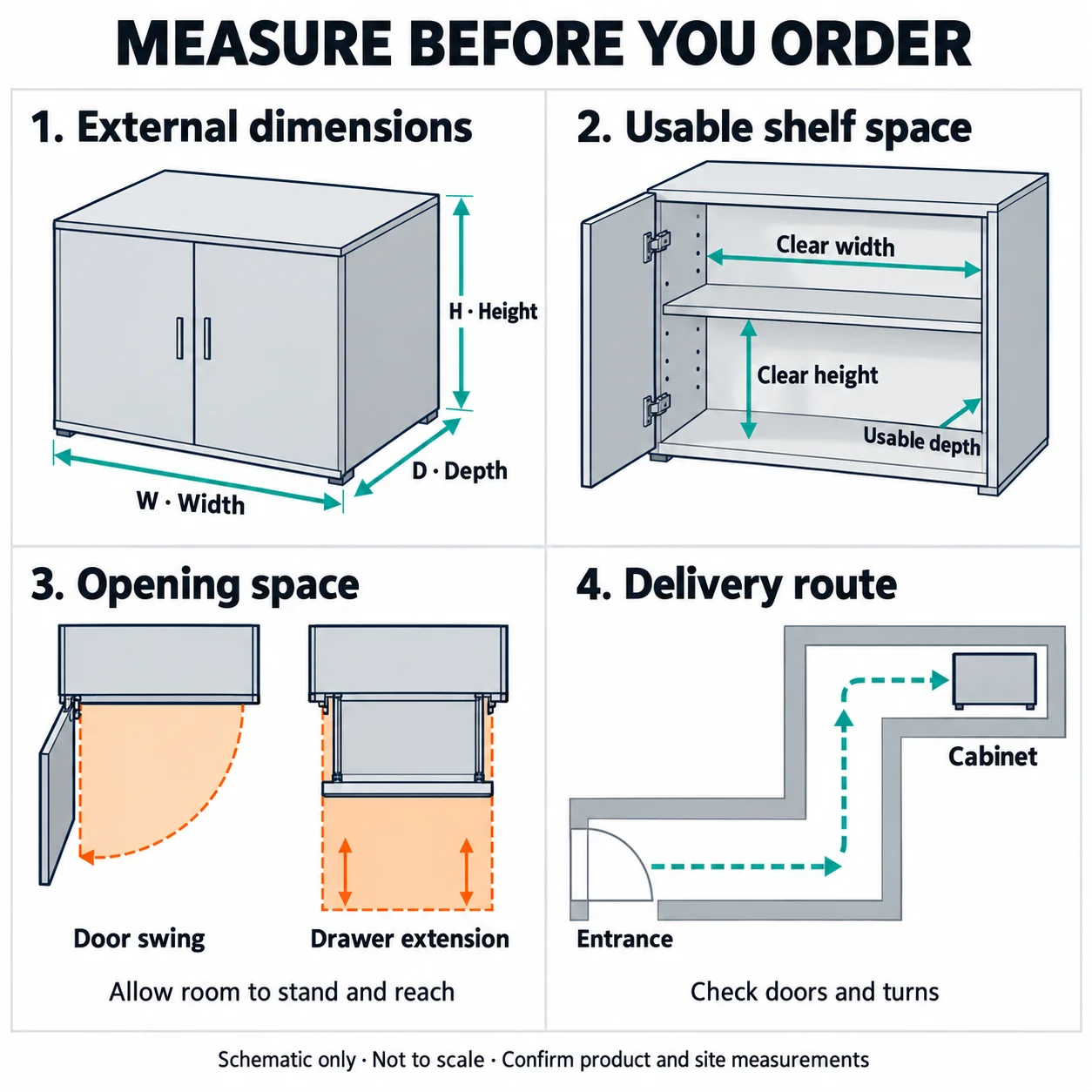
Office cabinet dimensions describe only part of the space required. Check three separate measurements before approving a layout.
External Dimensions: Width × Depth × Height
Request a drawing that identifies width, depth, and height. Check the proposed position against skirting boards, columns, sockets, switches, and nearby furniture.
Do not assume an unlabeled dimension sequence uses the same order across every supplier. Confirm what each number represents before using it in a floor plan.
Internal Dimensions: The Space Your Items Actually Use
External depth does not equal usable shelf depth. Panels, doors, partitions, and hardware take up space. Request the clear width, depth, and height of each compartment you intend to use.
Test the fit of a representative binder or box. Confirm shelf adjustability and load limits separately; a photo cannot establish either specification.
Operating and Delivery Clearances
Allow space for doors or drawers to open and for a person to retrieve contents without obstructing circulation. Check room doors, nearby desks, and chairs in their normal positions.
Then review the delivery route: entrances, corridor turns, lift doors, lift capacity, and final room access. Ask whether delivery is assembled or flat-packed and what assembly space is required.
4. Compare Shelves, Drawers, Materials, and Locks
Choose the internal layout around your storage list. Open shelves provide visible access; closed compartments keep contents out of view. Drawers may suit smaller items, but document storage requires confirmation of the intended filing system.
For materials and finishes, request the panel or frame specification, surface finish, edge treatment, and care instructions. Compare documented construction details rather than assuming a material name alone proves durability or moisture resistance.
Before shortlisting office storage units, ask:
- Are shelves fixed or adjustable, and what is the permitted load per shelf?
- Are drawers compatible with our file format or only general storage?
- Which doors or drawers lock, if any?
- What installation, leveling, or anchoring instructions apply?
- What warranty terms and replacement hardware support are included?
If the specification is missing, request written confirmation. Keep required features separate from optional preferences so suppliers can quote comparable configurations.
5. Compare Two Prospace Cabinet Examples
The models below provide a starting point for comparing a low and a taller configuration. Their product pages list the following dimensions; these are not measurements of usable storage space.
| Model | Prospace category | Dimensions listed on product page | Details to confirm before ordering |
|---|---|---|---|
| B-AG00201 | Low Storage Cabinet | 120 × 30 × 85 cm | Dimension-axis labels, internal clearances, shelf arrangement, locks, load limits, and installation requirements |
| B-AG00101 | Tall Storage Cabinet | 80 × 40 × 120 cm | Dimension-axis labels, internal clearances, shelf arrangement, locks, load limits, and installation requirements |
Specification source: linked Prospace English product pages, consulted 2 November 2026. Dimensions are reproduced in the sequence displayed. Confirm the latest specifications and availability with the team before purchase.
The comparison shows why cabinet selection should go beyond “low” or “tall.” These two listings differ across all three measurements. Request labeled drawings to assess placement, then check internal compartments against your storage list.
To review more configurations, compare office storage cabinets in the Prospace collection.
6. Prepare a Storage Quotation Request
A specific brief helps suppliers recommend relevant office organization furniture and identify missing information before quoting. Include the contents, intended location, access requirements, and delivery conditions.
Copy and complete this checklist:
Office storage RFQ brief
- Company and contact person:
- Delivery location, floor, and building access restrictions:
- Items to store, representative dimensions, and quantities:
- Access frequency and intended users:
- Number of cabinets required:
- Available placement area, with labeled dimensions or a floor plan:
- Preferred model or low/tall configuration:
- Required shelves, drawers, file format, and locking features:
- Material and finish requirements:
- Required delivery date and budget range, if available:
- Please confirm product specifications, availability, taxes, delivery, installation, and warranty terms:
For a wider purchasing project, use the office furniture procurement guide to coordinate storage requirements with your overall specifications and purchasing process.
Send your storage list and room dimensions to request a quotation. Contact the Prospace team on WhatsApp to discuss suitable configurations, current availability, and delivery requirements.
Frequently Asked Questions About Office Storage Cabinets
Is a Low or Tall Cabinet Better for a Small Office?
Compare the actual footprint, usable capacity, opening space, and user access. A taller unit may use wall height effectively, but it is not automatically narrower or shallower than a low cabinet.
How Do I Check Whether My Binders Will Fit?
Measure a representative binder and compare it with the compartment’s clear internal height and depth. Check usable shelf width and load rating as well. External cabinet dimensions alone cannot confirm binder capacity.
Can Any Cabinet Drawer Hold Hanging Files?
No. Confirm that the drawer includes a compatible hanging-file system for your documents. General storage drawers and shelves serve different purposes.
What Should I Check About Delivery Access?
Provide entrance and lift measurements, corridor constraints, delivery hours, and the final room location. Ask the supplier to confirm packaging dimensions, assembly arrangements, and any site handling requirements before ordering.