Office furniture procurement is more than selecting desks, chairs, and storage cabinets. For corporate procurement teams, purchasing managers, General Affairs (GA), and facilities professionals, it involves coordinating product specifications, supplier quotations, project budgets, delivery schedules, and workplace requirements.
For companies establishing or expanding offices in Indonesia, the process may also involve coordinating with regional management, local vendors, building management, and installation teams.
Without a structured approach, organizations risk purchasing furniture that does not match their workspace, overlooking installation costs, or accepting quotations that are difficult to compare.
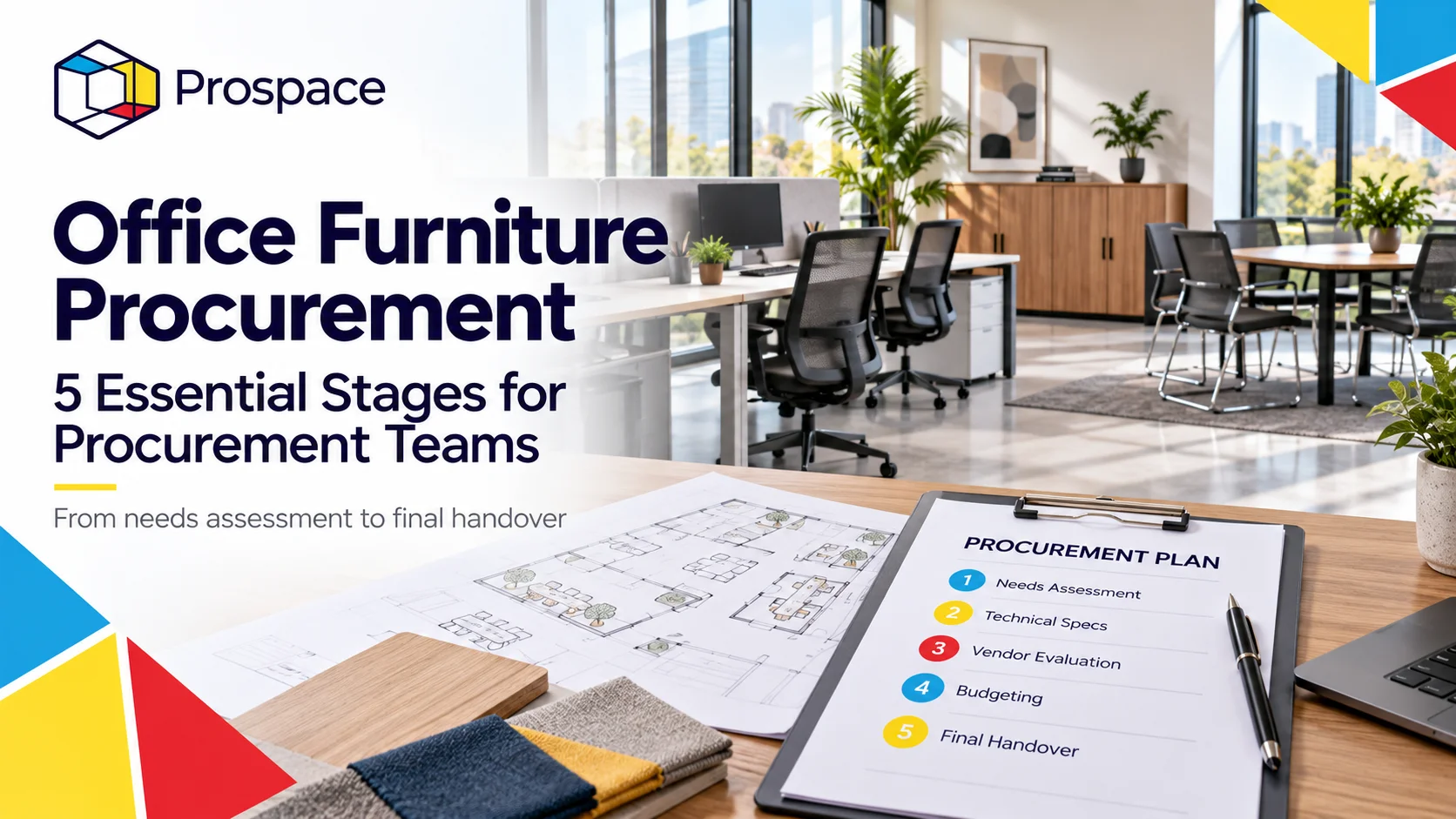
This guide covers five essential activities in the office furniture procurement process: defining requirements, preparing a Bill of Quantities (BOQ), requesting comparable supplier quotations, evaluating total costs, and managing installation and handover.
It also includes practical BOQ and RFQ examples, a supplier evaluation matrix, and inspection checklists that corporate teams can adapt to their projects.
1. Define the Scope and Prepare the Furniture BOQ
Before contacting suppliers, procurement teams need to establish exactly what the office requires.
A furniture procurement plan should consider more than the number of employees. It should also account for departmental functions, workspace layouts, meeting capacity, employee comfort, and potential future expansion.
For example, a finance department may require individual workstations and secure storage, while a collaborative team may need modular desks and flexible meeting areas.
Information to Collect Before Procurement
Start by gathering the following information:
- Employee capacity: Current number of users and expected future growth.
- Workspace layout: Floor plans, room dimensions, and available circulation space.
- Furniture categories: Desks, task chairs, executive furniture, storage, and meeting tables.
- Technical requirements: Dimensions, materials, ergonomics, finishes, and configuration.
- Project location: Delivery city, building access, and floor location.
- Budget: Approved expenditure limits and internal approval requirements.
- Project schedule: Intended office opening, renovation, or relocation date.
- Installation scope: Whether assembly, positioning, and removal of packaging are required.
These details form the foundation of the furniture Bill of Quantities.
What Is an Office Furniture BOQ?
A Bill of Quantities (BOQ) is a structured document listing the furniture items required for a project, including descriptions, specifications, quantities, and locations.
Unlike a general shopping list, a BOQ creates a consistent reference for supplier quotations, budget calculations, purchase orders, and delivery inspections.
Example: BOQ for Staff Workstations, Meeting Rooms, and Executive Areas
Consider a hypothetical corporate office in South Tangerang, Indonesia, with 24 staff workstations, two management offices, and one meeting room.
The following example demonstrates how its initial furniture BOQ could be organized.
| Furniture Item | Qty | Illustrative Requirements | Location |
|---|---|---|---|
| Staff office desks | 24 | Approx. 120 × 60 cm; durable work surface; cable management | Staff area |
| Ergonomic task chairs | 24 | Adjustable seat height; back support; suitable for daily use | Staff area |
| Management desks | 2 | Approx. 160 × 80 cm; storage provision | Management offices |
| Management chairs | 2 | Adjustable seating; specified upholstery and armrests | Management offices |
| Meeting table | 1 | Suitable for 8 users; cable access preferred | Meeting room |
| Meeting chairs | 8 | Stable construction; compatible with meeting-table height | Meeting room |
| Storage cabinets | 4 | Lockable compartments; dimensions subject to layout | Shared storage area |
Illustrative example only. Quantities and dimensions are hypothetical procurement requirements, not confirmed Prospace product specifications.
The procurement team should then review the list with department representatives and verify that the proposed dimensions fit the approved floor plan.
For workstation planning, teams can explore different office desk and workstation configurations before finalizing their technical requirements.
Practical deliverable: An approved furniture BOQ containing item descriptions, quantities, specifications, room locations, and priorities.
2. Compare Office Furniture Suppliers with a Consistent RFQ
Once the BOQ is approved, the next step is preparing a Request for Quotation (RFQ).
An RFQ is a formal request asking potential suppliers to provide commercial and technical offers for a defined set of requirements.
A common challenge in corporate furniture procurement is receiving quotations that cannot be compared directly.
One supplier might include delivery and installation, while another quotes only furniture prices. Some proposals may also use alternative materials or dimensions without clearly explaining the differences.
A standardized RFQ helps reduce these inconsistencies.
What Should a Furniture RFQ Include?
A corporate furniture RFQ should identify:
- Buyer and project information.
- Approved BOQ and technical specifications.
- Product quantities and delivery locations.
- Mandatory requirements and acceptable alternatives.
- Delivery and installation responsibilities.
- Requested implementation schedule.
- Warranty and after-sales information.
- Tax treatment and additional charges.
- Payment terms and quotation validity.
- Procedures for proposing substitutions.
Suppliers should be asked to indicate any deviation from the requested specifications rather than silently replacing the specified products.
Filled Example: Furniture RFQ for an Office Project in Indonesia
Below is an illustrative RFQ based on the BOQ above.
| RFQ Field | Example Requirement |
|---|---|
| Project | Corporate Office Furnishing – South Tangerang |
| Buyer | Example Corporate Procurement Team |
| Scope | Furniture supply, delivery, assembly, and positioning |
| Staff furniture | 24 desks and 24 task chairs |
| Management furniture | 2 desks and 2 management chairs |
| Meeting furniture | 1 meeting table and 8 chairs |
| Storage | 4 cabinets |
| Delivery destination | Corporate office, South Tangerang, Banten |
| Requested schedule | Delivery in project week 7; installation in week 8, subject to supplier confirmation |
| Installation requirements | Assembly, placement according to approved layout, and packaging handling |
| Commercial breakdown | Item price, quantity, delivery, installation, applicable taxes, and total quotation |
| Technical documents | Product specifications, dimensions, materials, and available product images |
| Warranty information | Coverage, exclusions, claim process, and applicable terms |
| Supplier response | Confirm compliance, state deviations, and identify any exclusions |
This is a hypothetical buyer request, not a real Prospace quotation, contractual commitment, or guaranteed installation schedule.
In practice, the buyer should attach the approved floor plan and BOQ so that all suppliers receive the same information.
How to Compare Supplier Quotations
Before comparing total prices, check whether every proposal covers the same scope.
A supplier quotation comparison should answer four questions:
- Does the furniture meet all mandatory technical requirements?
- Are the quoted quantities and product configurations equivalent?
- Are delivery, installation, taxes, and other charges clearly identified?
- Can the supplier meet the requested project schedule and service requirements?
A quotation with a lower product subtotal may become more expensive once additional logistics or installation charges are considered.
Example: Supplier Evaluation Matrix
A weighted evaluation matrix provides a documented way to assess potential suppliers.
| Evaluation Criteria | Example Weight |
|---|---|
| Technical compliance and product quality | 30% |
| Pricing and total procurement cost | 25% |
| Delivery and installation capabilities | 20% |
| Warranty and after-sales support | 15% |
| Relevant project experience | 10% |
| Total | 100% |
Each compliant supplier can be scored from 1 to 5 for each criterion.
For example, a supplier receiving scores of 4, 4, 3, 5, and 4 respectively would achieve a weighted result of 3.95 out of 5, or 79%.
These weights are illustrative and should reflect each organization’s procurement policies.
Importantly, mandatory compliance requirements should be evaluated separately. A high weighted score should not compensate for failure to meet a critical specification.
Practical deliverable: A supplier comparison sheet documenting technical compliance, commercial offers, exclusions, and the reasons for the final recommendation.
3. Evaluate Product Samples and Total Cost of Ownership
Price is an important consideration, but it should not be the sole basis for supplier selection.
For furniture used daily over several years, material durability, user comfort, replacement needs, and after-sales arrangements can influence the overall investment.
This is why procurement teams should evaluate both physical product quality and Total Cost of Ownership (TCO).
What to Verify on Office Chairs, Workstations, and Meeting Tables
Office chairs
When evaluating office chairs for corporate workspaces, inspect:
- Seat dimensions and adjustment range.
- Backrest and lumbar support.
- Armrest configuration.
- Tilt and reclining mechanisms.
- Upholstery and frame materials.
- Base stability and caster function.
- Declared load capacity.
- Warranty coverage and exclusions.
For larger purchases, requesting a sample or visiting a showroom allows representative employees to assess comfort and functionality.
A chair that meets the purchasing budget but performs poorly during regular use may not provide the best long-term value.
Office desks and workstations
Check the following:
- Desktop dimensions and material specifications.
- Frame construction and stability.
- Surface finish and edge quality.
- Cable management provisions.
- Storage and privacy requirements.
- Compatibility with the approved office layout.
- Available modular configurations.
For shared workspaces, it is particularly important to confirm whether workstation arrangements provide sufficient usable space and access.
Meeting tables
Review available meeting table options against the room layout and intended seating capacity.
Check tabletop dimensions, stability, materials, cable access, and whether the proposed design can be transported and assembled inside the building.
Understanding Total Cost of Ownership
Total Cost of Ownership considers the expenditure associated with furniture over a defined period, rather than focusing exclusively on purchase prices.
A procurement cost assessment may include:
| Cost Component | What to Evaluate |
|---|---|
| Initial purchase | Unit prices multiplied by quantities |
| Delivery | Transport, unloading, and handling |
| Installation | Assembly, positioning, and associated services |
| Taxes | Applicable taxes and invoice requirements |
| Maintenance | Cleaning, adjustment, and routine servicing |
| Repairs | Potential repair costs and component replacement |
| Replacement | Expected future replacement expenditure |
Consider two office chair proposals with different purchase prices.
The less expensive option may appear preferable initially. However, if it has shorter expected service life, more expensive replacement components, or limited service support, its overall ownership cost could be higher.
This does not mean the more expensive chair is automatically better. Procurement teams should compare documented product specifications, applicable warranty terms, and reasonable maintenance assumptions before deciding.
Evaluate Supplier Reliability and After-Sales Support
For corporate furniture procurement in Indonesia, supplier evaluation should also consider operational readiness.
Before issuing a Purchase Order (PO), verify:
- Relevant experience with comparable workplace projects.
- Availability of product samples or showroom inspection.
- Proposed stock availability or production arrangements.
- Confirmed delivery and installation scope.
- Communication and escalation contacts.
- Written warranty and after-sales terms.
- Procedures for handling damaged or non-compliant products.
These checks are particularly relevant to office relocation, renovation, and multi-category furnishing projects.
Practical deliverable: A documented technical evaluation and cost comparison supporting the purchasing decision.
4. Plan Delivery, Installation, and Final Handover
Furniture procurement is not complete when the Purchase Order is issued.
Delivery coordination, building access, installation, inspection, and final acceptance can determine whether the office is ready for occupation on the intended date.
For projects in Indonesia, procurement teams should confirm practical site conditions early, particularly when delivery takes place in commercial buildings or offices with controlled loading areas.
Confirm Site Readiness Before Delivery
Before scheduling furniture delivery, verify:
- Building loading dock access and operating restrictions.
- Freight elevator availability and dimensions.
- Delivery floor and access routes.
- Required building management permissions.
- Available space for unpacking and assembly.
- Whether flooring, electrical work, and other fit-out activities are complete.
- Responsibility for packaging removal.
- On-site representatives authorized to receive deliveries.
These requirements should be communicated to the supplier before the installation schedule is finalized.
Example: Procurement and Installation Milestones
A project schedule should establish clear responsibilities and approval points.
| Milestone | Main Activity | Responsible Party |
|---|---|---|
| Requirements approval | Finalize furniture BOQ and floor plan | Procurement / GA |
| RFQ and comparison | Obtain and evaluate supplier proposals | Procurement |
| Commercial approval | Approve supplier and procurement budget | Authorized management |
| Purchase Order | Confirm models, quantities, prices, and terms | Procurement / Supplier |
| Site readiness | Confirm access and installation conditions | GA / Facilities |
| Delivery | Receive and count furniture items | Supplier / Receiving team |
| Installation | Assemble and position furniture | Assigned installation team |
| Inspection | Verify condition, quantity, and specifications | Procurement / GA |
| Handover | Document acceptance and outstanding issues | Buyer / Supplier |
The actual duration of each milestone depends on project scope, product availability, site readiness, and agreed supplier commitments.
Example: Office Furniture Inspection Punch List
A punch list is a record of outstanding defects, missing items, or incomplete work identified during inspection.
Using one helps procurement teams avoid relying on informal conversations after installation.
| Item | Inspection Finding | Required Action | Status |
|---|---|---|---|
| Workstation WS-04 | Desktop finish scratched | Inspect and agree corrective action | Open |
| Task chair CH-11 | Height adjustment not functioning | Repair or replace as agreed | Open |
| Storage cabinet CB-02 | Lock mechanism not operating properly | Inspect and rectify | Open |
| Meeting table MT-01 | Installed according to approved layout | No action required | Accepted |
Illustrative punch list only; these are not findings from an actual Prospace project.
For real projects, each issue should include photographic evidence, an assigned responsible party, an agreed corrective action, and a target resolution date.
Documents to Retain After Handover
A complete procurement record may include:
- Approved BOQ and technical specifications.
- Supplier quotations and evaluation results.
- Purchase Order or contract.
- Delivery notes.
- Inspection reports and photographs.
- Outstanding-item or punch-list records.
- Warranty documentation.
- Final acceptance or handover records.
Acceptance procedures should follow the company’s internal purchasing requirements and the agreed contract.
Practical deliverable: A verified delivery record, completed inspection checklist, documented outstanding items, and formal handover confirmation.
5. Review a Documented Prospace Office Furniture Project
Reviewing completed project documentation can help corporate buyers understand how furniture specifications translate into actual workspace configurations.
A relevant example is the Xiaomi Indonesia office project documented by Prospace.
Project Reference: Xiaomi Indonesia Office

- Modular white workstations arranged to support daily operations and collaboration.
- Orange privacy panels reflecting Xiaomi’s visual identity.
- Ergonomic office chairs paired with individual workstations.
- Individual storage cabinets for organized work areas.
- Furniture arrangements intended to create a modern, functional office environment.
The published scope identifies office interior design and furniture, with an emphasis on modular, ergonomic, and organized workstations.
For procurement teams, this project illustrates the importance of coordinating several furniture categories within a consistent workplace layout rather than evaluating individual products in isolation.
For example, workstation arrangements, chair dimensions, storage placement, and privacy requirements should be considered together during the specification stage.
The project documentation does not establish specific procurement quantities, project prices, delivery durations, or measured business outcomes. Those details should not be assumed from the photographs or project description.
Corporate buyers can use the project as a visual reference while requesting additional technical and commercial information relevant to their own requirements.
6. Request an Office Furniture Project Quotation
After defining your furniture requirements and establishing an initial BOQ, the next step is to obtain a quotation based on the actual project scope.
Prospace provides office furniture for corporate workspaces, including office desks, chairs, workstations, meeting tables, and storage furniture.
For projects involving multiple furniture categories, discussing product configurations and installation requirements together can help clarify the quotation scope.
Information to Prepare Before Contacting Prospace
For a more specific project discussion, prepare:
- Company name and procurement contact.
- Number of users and estimated furniture quantities.
- Project location, including city and building information.
- Furniture BOQ or requirements list, if available.
- Floor plan, where available.
- Target project schedule and intended occupancy date.
- Budget range, where approved for supplier discussion.
If your BOQ is not finalized, an initial furniture list and floor plan can still serve as a starting point.
Send your furniture list and floor plan for a project quotation.
Visit the Prospace contact page to discuss your office furniture requirements with the team.
Product availability, quotation terms, delivery schedules, installation scope, and after-sales arrangements should be confirmed for the specific project before a purchasing commitment is made.
7. Office Furniture Procurement FAQ
What is the standard office furniture procurement process?
A structured process generally includes five activities: assessing furniture requirements, preparing the BOQ and specifications, obtaining and evaluating RFQs, approving procurement and implementation arrangements, and inspecting products before handover.
The specific approval stages may vary depending on the organization’s purchasing policy.
What is the difference between a furniture BOQ and an RFQ?
A BOQ (Bill of Quantities) lists the furniture items, quantities, descriptions, and technical requirements needed for a project.
An RFQ (Request for Quotation) uses those requirements to request pricing, technical proposals, delivery information, and commercial terms from suppliers.
The BOQ defines what the buyer needs; the RFQ asks suppliers how they propose to fulfill those requirements.
What documents are needed for corporate furniture procurement?
Common documents include a requirements list, BOQ, technical specifications, RFQ, supplier quotations, evaluation matrix, Purchase Order, delivery notes, inspection records, and handover documentation.
Additional documents may be needed according to company policies and contractual requirements.
How should corporate teams evaluate an office furniture supplier in Indonesia?
Evaluation should consider mandatory specification compliance, product quality, quotation completeness, total project cost, relevant experience, delivery and installation capabilities, and documented after-sales arrangements.
For larger orders, sample inspections and reference projects can provide useful supporting evidence.
What should be included in an office furniture procurement budget?
A complete budget should account for furniture quantities and unit prices, delivery, installation, applicable taxes, accessories, site handling, and other agreed project expenses.
Where appropriate, the buyer may also consider maintenance and replacement costs through a Total Cost of Ownership assessment.
Should procurement teams request furniture samples before bulk purchasing?
Sample inspections can be particularly valuable for frequently used items such as task chairs and workstations.
They allow teams to assess dimensions, materials, mechanisms, stability, and usability before confirming larger quantities.
Can Prospace support corporate office furniture procurement projects?
Prospace offers office furniture categories for corporate workspaces and publishes examples of completed office projects, including Xiaomi Indonesia.
Companies can contact Prospace to discuss furniture requirements, proposed quantities, workspace layouts, and available project services. The precise scope and commercial arrangements should be confirmed with the team.
Conclusion: Build a More Reliable Furniture Procurement Process
Effective office furniture procurement in Indonesia requires coordination between purchasing teams, workplace managers, suppliers, and installation stakeholders.
A clear BOQ establishes what the organization needs. A consistent RFQ makes supplier quotations easier to compare. Product inspections and total cost assessments support better purchasing decisions, while documented delivery and handover procedures help manage implementation risks.
For corporate teams, these practices provide a more transparent and accountable foundation for furnishing new offices, expanding existing workplaces, or replacing aging furniture.
Start with a documented furniture requirements list, validate the technical scope, and obtain supplier quotations that can be compared consistently.
For a project-specific discussion, contact Prospace with your furniture requirements, quantities, location, and proposed timeline.
Prefer reading this guide in Bahasa Indonesia? See the Panduan Lengkap Pengadaan Furniture Kantor untuk Tim Procurement.